- Author:
- Tillie Dee
- Date:
FAQ: You asked, we answered: your questions from People in the Lead
Our webinar ran over, so the questions never got their turn. Here are our answers to every one.
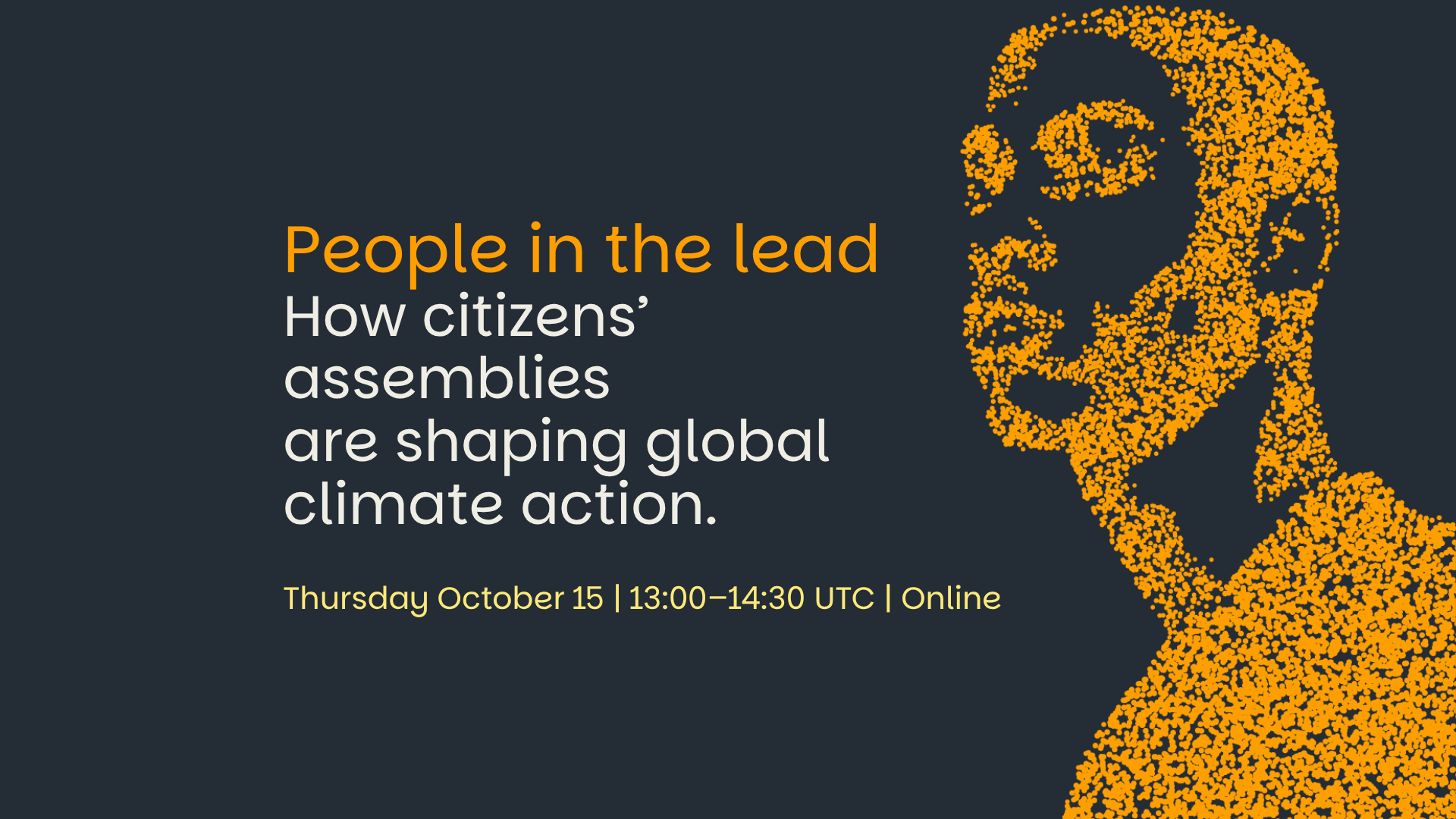
On 15 October, more than 160 people joined us live for People in the Lead: How citizens' assemblies are shaping global climate action. Over an hour and a half, we heard from members of the Global Assembly on Food and Climate, community organizers who have run their own assemblies, leading experts on climate and democracy, and officials from COP30 and COP31.
The chat was full of sharp, generous and challenging questions. Our speakers had so much to say that we ran over and lost the live Q&A, so we promised to answer every question in writing.
Here they are, grouped into three themes: who takes part, how conversation turns into change, and what comes next.
Who takes part
Are people put off taking part because they worry others will make assumptions about them, or that they'll have to defend their views?
This can be a challenge for any citizens' assembly, and we take it seriously.
For the Global Assembly on Food and Climate, recruitment was done by local partners on the ground. They deliberately recruited a diverse group from their local population. Part of their job was to explain the process to people before they signed up: that it is a safe space, that a trained facilitator makes sure everyone is heard equally, and that everyone is treated with respect throughout.
Two design choices also help. No expertise is required, so nobody is expected to arrive with the "right" answers. Members bring their lived experience and are supported with balanced learning materials and expert input. Assembly Members are also paid for their time, so taking part isn't limited to people who can afford to volunteer.
Who are the people taking part in the assemblies? Is there data on this?
It depends on which part of the Global Citizens' Assembly you mean.
The Global Assembly is a representative group chosen by lottery, not by application. For the 2026 Global Assembly on Food and Climate, 105 members from more than 60 countries were selected in two stages. First, a geographic lottery picked locations, weighted towards the regions most vulnerable to climate change. Then a demographic lottery selected members so that the group mirrors the world's population by age, gender, education, geography, whether people live in cities or the countryside, and their views on climate change.
You can find the full demographic breakdown, with charts, in the Methodology and Outputs report.
Community Assemblies are different by design. They are open: anyone, anywhere can host one, and anyone can take part. That means they aren't a statistical sample of the world, and they aren't meant to be. Their strength is reach and local depth.
Could there be permanent Assembly Members, involved over a long period? Wouldn't that be a better way to discuss global issues that affect us all?
There are really two ideas here, and our answer differs for each.
A permanent Global Citizens' Assembly: yes, that's the goal. Making the Global Citizens' Assembly a permanent institution is one of the four asks we and our coalition partners are making in the run-up to COP31. The other three are a Citizens' Track Unit within the UN climate process, an annual reporting and response mechanism, and scaling participation to one million people by 2028.
Permanent members: no, and that's deliberate. A permanent institution doesn't need permanent members. What keeps the assembly representative is a fresh group of people, selected by lottery for each assembly. Long-term membership creates three problems:
- Drop-out and burnout. Taking part already asks a lot of people's time over several weeks. Stretch that over years and many people drop out, leaving only those with lots of free time or an unusually strong sense of civic duty.
- It shuts out everyday people. Long commitments filter out people with demanding jobs or caring responsibilities. An assembly needs exactly those people to be representative, and representativeness is where its legitimacy comes from.
- Members become professionals. Sit on an assembly long enough and you stop being an "everyday person". You start to become part of a professionalised group that can lose touch with the wider public.
From conversation to change
Community assemblies let people talk about climate and ecological collapse. But how does that turn into the power to change policy?
Problems like climate change and AI are planetary. No single global institution can solve them alone, and neither can local action on its own. Change comes from many centres of power, at many levels, learning from and pushing each other.
The Global Citizens' Assembly is designed to act as a bridge between those levels: between local communities, national governments, international organisations and scientific networks. It has two parts that reinforce each other:
- a Global Assembly, chosen by lottery to reflect the world's population, working at the planetary scale
- a network of Community Assemblies, rooted in particular places and lived realities
Together they link global decision-making with local experience.
So a community assembly's impact isn't only measured by whether a government adopts its recommendations. We look at five pathways: institutional action, citizen action, solidarity, learning at scale and inclusion.
Institutional action does happen too. Insights from community assemblies are being presented at the UN climate talks, alongside the Global Assembly's 22 Calls to Action and deep dives. Locally, the London People's Assembly on Food, Nature and the Right to Grow put its recommendations directly in front of London's Deputy Mayor for Environment.
How are Assembly Members protected, and how do the recommendations keep their impact if governments don't like the results, or reject the science altogether?
Protecting people. Assembly Members are recruited and supported by local Community Hosts, who also provide translation and practical help. Sessions are run by trained facilitators whose job is to make sure everyone is heard and respected. Members are paid for their time.
Protecting impact. The Global Assembly's 22 Calls to Action each won the support of at least 85% of members, a level of agreement that is rare in international policy. The full method, data and outputs are published, so anyone can check how the recommendations were reached. The recommendations are being presented at the request of the Government of Brazil, with a coalition that includes the governments of Brazil, Vanuatu and Ireland. And one of our core asks is a guaranteed annual reporting and response mechanism through a Citizens' Track, so that decision-makers have to respond formally to the Assembly, whatever their politics.
Winning acceptance. Legitimacy is in the eye of the beholder. The art of designing a process is to balance a wide range of perspectives in a way that most people, including those in power, will see as fair, and to show transparently how that was done. Choices about the type of process, how participants are recruited and how it is communicated are made with the political and institutional context in mind.
Has the Global Citizens' Assembly, or Assemblis, deliberated on how to return control of financial institutions (private, public and multilateral) to citizens?
Time and again, the questions and trade-offs that surface in assemblies come back to who actually holds power over the resources, the land and the financial systems that shape our lives.
Where deliberative democracy reclaims our political agency, commoning reclaims our economic agency: land, energy, food, housing and care, held and managed collectively rather than left to markets or the state alone. A lot of work is happening in communities around the world to do exactly that.
What's next, and how to get involved
Is there room for assemblies on specific sectors, such as water, energy or defence?
There are many topics the Global Citizens' Assembly could take on, including the ones you mention. What matters is that the agenda is set in a way that is both legitimate and impactful.
How topics are chosen for future assemblies will be decided by the Global Citizens' Assembly's governance bodies. It could be a bottom-up process, with community assemblies choosing the topic, or topics could be proposed by institutions. No decision has been made yet about future topics. The model is being built so it can be applied across issues, including climate change, AI governance and global health, starting with food.
In the meantime, anyone can run a community assembly on any topic that matters to their community, using the free guide on Assemblis.
Should we all share a common vision of the future we want to create? Do we need to agree on it, and what basic needs might we all share?
We don't think everyone needs to agree on everything, and assemblies aren't designed to force agreement. What they do is help very different people find common ground they can stand behind, and be honest about where the hard choices lie.
How can I connect with people working on the Global Citizens' Assembly where I live, for example in Nigeria?
The best place to start is Assemblis, our free digital platform for community assemblies. You can see assemblies that have already taken place around the world, read the guide to hosting your own, and share what your assembly finds so that it feeds into the Global Citizens' Assembly. More detailed guidance is coming soon.
Keep the conversation going
Thank you to everyone who joined us and asked such thoughtful questions. They made us think, and some will shape what we do next.
If you'd like to go further:
Read the recommendations: the 22 Calls to Action and the full Methodology and Outputs report
Run your own assembly: start with Assemblis and the community assembly guide (also available in Spanish)
Stay in touch: sign up to our newsletter and follow us on LinkedIn and Instagram