- Home >
- insights >
- ahmad story
How Ahmad, an Indonesian fisherman, is taking coastal realities to the global stage
What happened when a fisherman from Indonesia’s coast joined the Global Assembly on Food and Climate? For Ahmad Marzuki, it meant taking the realities of declining fish stocks, displacement and community resilience all the way to the international stage.
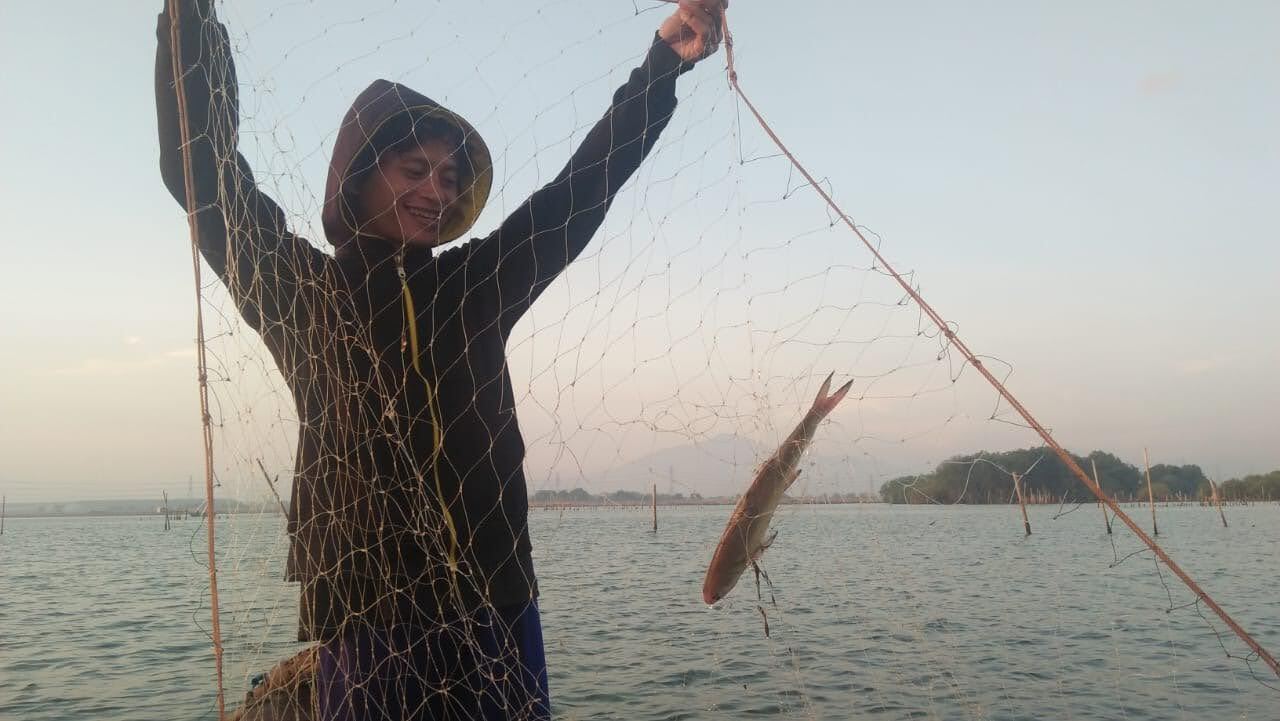
At 3am every morning in Semarang, Indonesia, Ahmad Marzuki heads out to sea with his nets. Some mornings, the catch is enough to sustain his family and community. More often now, it is not.
“The rising temperatures have really affected my work,” he says. “A few years ago, catching twenty or twenty-five kilos a day was easy. Now even four or five kilos is difficult.”
Displaced, but not silenced
For Ahmad, the sea and daily catch is not his only vulnerability. In 2019, flood-control projects displaced him and his community of 164 people from their homes. They were moved into ”temporary” housing. Years later, it remains temporary.
“In Indonesia we say fishermen are the pillars of protection,” he explains. “We provide protein for families. Yet small communities like ours always seem to suffer first.”
Since then, Ahmad and others around the community have organized, petitioning to regain fair access to the sea and coastal areas and for safer housing. The effort has been persistent, but progress slow.
“Sometimes it feels like our voices don’t reach very far,” he says.
An unexpected opportunity
But, it was through one of these local efforts, an unexpected opportunity emerged. At a community event run by a local non-governmental organization, Ahmad was invited to take part in the Global Citizens’ Assembly on Food Systems and Climate, a global initiative bringing together everyday people to share how climate change is reshaping the way they grow, find, and rely on food.
In this process, a diverse group of citizens (aiming to reflect the world’s population across age, gender, income and education) come together to answer a pressing question: how can food systems become fairer and more resilient in a warming world?
“I thought, at first, it would just be something to keep me occupied,” Ahmad says. “It was the lean season for fishermen so we don’t have a lot of work.”
The selection process followed a method known as sortition, a lottery designed to produce a representative group.
Organisers began by using an algorithm to randomly pick locations across the globe, giving slightly more weight to areas most vulnerable to climate change. In each location, local partners helped identify a pool of potential participants. From there, individuals were selected by lottery that aims to mirror global diversity in age, gender, income, education, and life experiences. Ahmad was amongst them.
Citizens’ assemblies have been slowly gaining ground. In Ireland, they helped change abortion laws. In Austria, an heiress let citizens decide how to spend her $25 million fortune. Today, many European cities use citizens’ assemblies as a regular part of how decisions are made.
The Global Citizens’ Assembly took this idea further. For the first time, people from around the world came together to discuss food systems, a sector that creates about a third of global greenhouse gas emissions. It included voices often missing from international negotiations, which usually happen far from the communities most affected.
105 people, one question
For seven weeks, from January to March 2026, 105 participants met online, joining sessions across time zones twice a week. They ranged from teenagers, right up to people in their eighties. Together with Ahmad was a farmer in Uganda, a student in Brazil, an engineer in Turkey, and many small business owners. Some grow their own food, others rely on supermarket supply chains.
The first couple of weeks were about learning. Participants heard from scientists, policy experts, and indigenous leaders and explored how food systems contribute to climate change, and how history, economics, and politics shape what people grow, sell, and eat.
"Food systems are part of the problem"
For Ahmad, it changed how he saw the problem.
“I never thought about environmental damage coming from the food we grow and eat,” he says. “I used to think about pollution from cars or factories. But I learned how food systems are part of the problem too.”
From listening to decision-making
As the weeks progressed, the conversations deepened. Participants moved from listening to questioning, asking who should bear the cost of change, how to balance local livelihoods with global trade, and what trade-offs might be necessary.
The discussions were not always easy. People brought different assumptions and priorities to light. But the structure of the Assembly encouraged something rare - a sustained, respectful exchange. where participants didn’t simply defend fixed positions but listened, reflected, and let their views evolve.
“I remember at the beginning, there was a farmer in my group, and a lot of the conversation was very focused on agriculture,” he says. “I understood that, but I wanted them to also see the challenges we face as fishermen. Our struggles are different, but connected. Over time, we started to understand each other better.”
Ideas were tested, challenged, and revisited. Gradually, positions shifted, not all at once, but through conversation.
By the final week, the group had moved from discussion to decision-making. Participants voted on a set of proposals, each one developed through weeks of structured deliberation.
Calls for global action
Twenty-two Calls to Action were agreed, all supported by more than 80% of the Assembly.
Proposals ranged from technical reforms, like clearer sustainability labelling and stricter regulation of harmful chemicals, to more structural changes, like the redistribution of subsidies. Some recommendations also addressed culture, such as the preservation of local food traditions.
The Global Citizens’ Assembly has gathered global support, from governments and non-governmental organizations alike. The government of Brazil, which was presiding over the UN climate negotiations in 2025, endorsed the efforts of the Global Citizens Assembly and invited it to present its recommendations at upcoming international meetings this year. This way, Assembly Members, like Ahmad, will get the chance to share their stories and their lived experiences at moments they are traditionally excluded.
In addition to influencing global policy, it also delivers concrete change on the ground.
Back in Semarang, Ahmad has begun to apply what he learned. He is working with others to restore coral reefs and protect seagrass beds, recognising their role in sustaining marine ecosystems.
“I hope everyone becomes more aware of the environment,” he says. “Governments need to take responsibility, and communities need to take action.”
This article was first published in the Equatorial.