- Home >
- insights >
- annas story
The Ugandan dairy farmer helping to reshape global climate decisions
As erratic weather threatens the farms and livelihoods of small-scale producers in Western Uganda, dairy farmer Anna Mbabzi joined the 2026 Global Assembly on Food and Climate to bring the realities of rural farming, and the case for supporting small farmers, into the conversations shaping the future of global food systems.
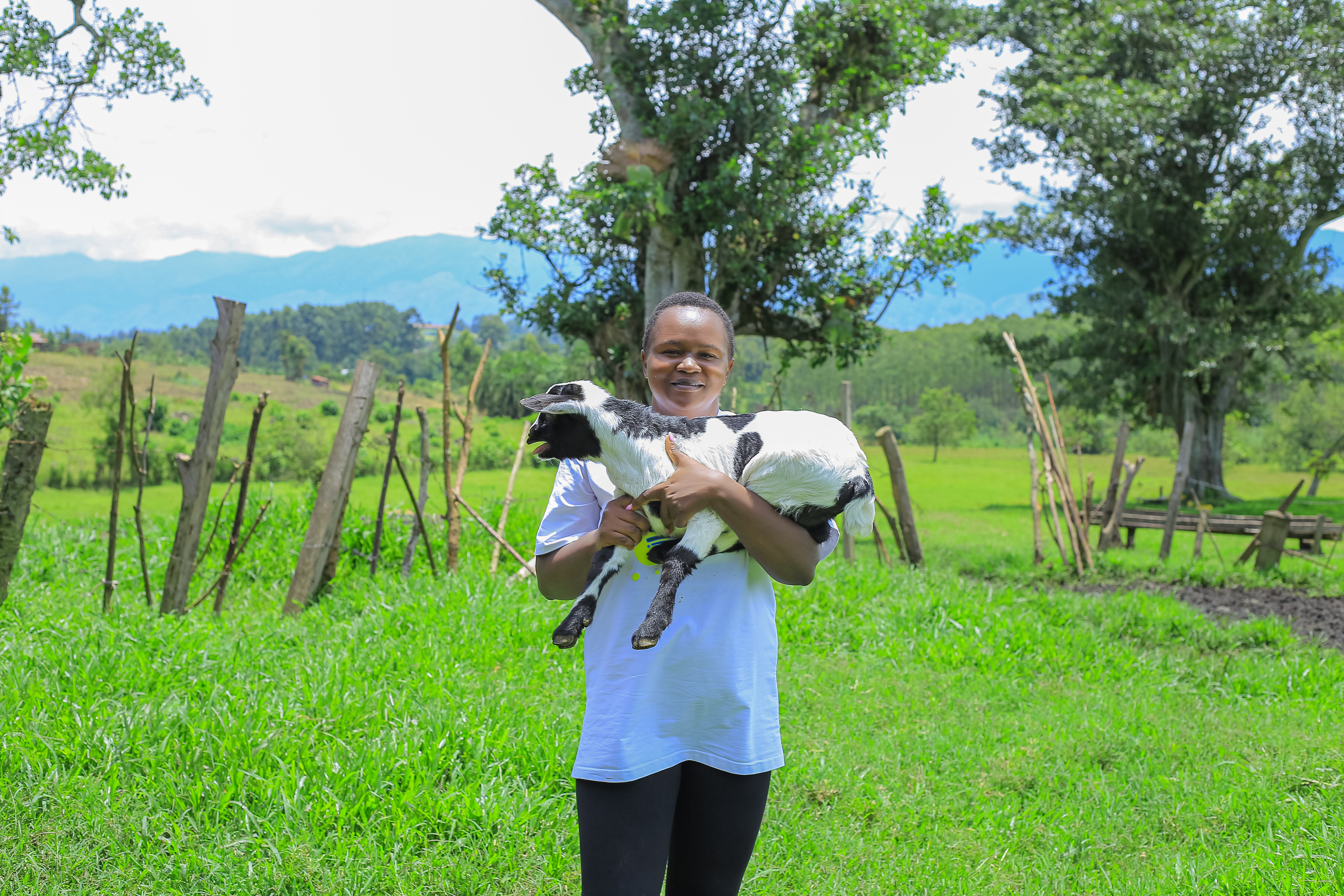
At 5 AM each morning in Western Uganda, Anna Mbabzi wakes up to begin her day. By mid-morning, she is out in the fields, planting maize. In the afternoon, she tends to her animals. By evening, she is milking cows and preparing deliveries for her local cooperative.
Her farm, in Fort Portal, is small but busy. Twenty dairy cows. Fifty goats. Around twenty seasonal workers, most of them women, some single mothers who bring their children along as they work.
“I support them, and they support me,” she says. “We’re a close community here.”
But life on the farm is unpredictable.
“The weather is not like it used to be,” she says. “We have droughts, then floods. It damages how people earn a living. When you cannot plan, you lose.”
Beyond the farm and beyond her comfort zone
Last year, Anna received a phone call that would take her far beyond her farm, and comfort zone. She was invited to apply for the Global Citizens’ Assembly on Food Systems and Climate - an initiative designed to put people at the centre of global decision-making. Through it, a diverse group of citizens would come together to tackle a pressing question: how to make food systems fairer and more resilient in the face of climate change.
The selection process aimed for global representation. First, an algorithm chose random locations around the world with a slight over-representation for locations with higher risk to climate change. In each location selected, organizers worked with local partners to identify a pool of possible candidates. From this pool, one person was chosen by lottery, using a method known as sortition. This resulted in a group that aims to reflect global diversity in age, gender, income, education, and life experience. Anna was among them.
“I was so happy,” she says. “Food and climate are part of my everyday life.”
An assembly of people spanning the globe
Citizens’ assemblies have been quietly gaining traction. In Ireland, they helped reform abortion laws. In Austria, an heiress let citizens decide how to spend her $25 million fortune. Today, many European cities have made citizens assemblies a permanent part of governance, adding a new, deliberative layer to how decisions are made.
The Global Citizens Assembly marked a further step. It was the first time such a process had been convened at a global scale around food systems, a sector responsible for roughly a third of global greenhouse gas emissions. It brought into conversation people whose perspectives are (often) absent from international negotiations, which tend to unfold at a distance, geographical and otherwise, from the farms and communities most directly affected.
How the Global Citizens' Assembly worked
The Assembly ran online for seven weeks from 17 January to 14 March 2026, with two three-hour sessions each week. Its 105 members ranged from teenagers to people in their eighties. The group included a fisherman in Indonesia, a student in Brazil, an engineer in Turkey, and small business owners. Some live in rural villages and grow their own food, others in busy cities with easy access to food from large supermarkets.
Over the course of the sessions, participants heard from scientists, policy experts, and Indigenous leaders, and were introduced to the historical and structural dimensions of global food systems.
The discussions returned to questions that were more immediate like who should bear the cost of reform? How should local production be balanced against global trade? What changes are feasible, and what trade-offs are unavoidable?
Finding common ground on contested topics
For Anna, one thing stood out.
“I realized we are one world,” she says. “I spoke to people on the other side of the world also dealing with crop loss, just like us.”
One of the more contested topics for Anna was agricultural subsidies, public funds intended to support farmers. Some participants argued that larger producers, by virtue of feeding more people, should receive greater support. Others questioned whether scale alone should determine allocation.
The discussion, while marked by disagreement, remained notably measured. Participants asked questions, drew on personal experience, and, at times, reconsidered their positions.
Anna shared her experience. “As a small farmer, supplies are very expensive,” she says. “Labor is expensive. When you calculate everything, you earn very little.”
She explained how many farmers in Uganda work in informal systems and face rising costs.
“That’s where the pain is,” she says.
As more people shared their lived experiences, the conversation began to shift. It became less about theory and more about real lives. In the end, the group agreed on a recommendation: most agricultural subsidies should go to small-scale farmers.
“For me, that was the right thing,” Anna says. “These are the people holding our environment together.”
Calling for global action
In its final week, the Assembly agreed and decided on 22 Calls to Action aimed at decision makers at all levels, from mayors and community leaders to world leaders, which were all actively supported by a super-majority of over 80% of Assembly Members.
The proposals ranged from technical reforms, such as clearer sustainability labelling and stricter regulation of harmful chemicals, to broader structural changes, like the redistribution of subsidies and increased investment in rural infrastructure and knowledge systems. Some recommendations addressed culture, emphasizing the preservation of local food traditions.
These decisions were not easy. Members had to grapple with complex trade-offs, such as balancing local livelihoods with global sustainability and short-term gains with long-term resilience. The Assembly’s process showed that tackling these challenges requires time, evidence, and the willingness to work together, and that structured and inclusive deliberation can produce solutions that are both practical and widely supported.
The Global Citizens’ Assembly has support from governments and non-governmental organizations around the world. Climate policymakers have asked to hear its recommendations at major international meetings, bringing everyday voices, like Anna’s, into the highest levels of climate governance. Assembly Members will also have the opportunity to share their stories and experiences at climate events, helping ensure these perspectives are seen and heard.
But, more than just influencing global policy, it is also changing things on the ground.
"The solutions already exist"
Back in Uganda, Anna is already putting what she learned into practice. She plans to expand agroforestry, planting trees alongside crops to protect soil and guard against extreme weather. “We plant a tree every birthday for my daughter,” she says. “Now I want to do more, planting trees every month. I also want to teach my community to do this too.”
Her message is simple: listen. “My biggest hope is that leaders across Africa and around the world listen to the people,” she says. “Because the solutions already exist, in farms, in families, in communities. When ordinary people are truly included, we can build a better future together.”